Top Credit Cards in India
Choose cards based on your real life: groceries and online shopping, food delivery, movies, flights and hotel stays, fuel and everyday bills. This guide is written in plain language and focuses on how you actually spend money in India. It compares rewards, annual fees, lounge access and partner offers, and shows you when a card truly helps you save without adding stress. If you prefer a straightforward cashback card or want travel and lifestyle benefits, you’ll find curated picks below with visuals, benefits and quick apply links.
Categories
- Cashback and rewards
- Travel and lounge access
- Fuel and co-branded cards
Use the Credit Card EMI Calculator to estimate EMI on large purchases. It projects EMI, interest and processing fees, helping you compare true cost before you convert a purchase to EMI.
Recommended Links
How we picked
We focused on cards that feel good to use every day, not just on paper. That means strong rewards in real categories, simple terms, and perks that you’ll actually use—cashback on online spends, food and movies, shopping on popular apps, and a sensible path to building a healthy credit profile. If a card helps you save without stress, it makes the shortlist.
While comparing “best credit cards in India”, we prioritized trending use-cases: online shopping rewards, cashback credit cards, travel credit cards with lounge access, lifetime free or low annual fee options, and cards that provide consistent value beyond welcome gifts. We avoided confusing point structures with low real value and highlighted programs with transparent redemption. Keywords you’ll naturally find here include cashback cards India, travel cards India, lounge access cards, lifetime free credit cards, low annual fee credit cards and apply credit card online India.
Card-by-card picks

SBI Cashback Credit Card
Simple cashback on online and offline spends. Ideal for heavy online shoppers who want straightforward savings without micro-managing categories.
- 5% cashback on online spends; 1% on offline spends
- Clean statement credit—easy to track savings
- Use as your daily driver for most online payments

Axis My Zone Credit Card
Fun lifestyle perks for food and movies. Great if weekends mean Swiggy and cinema, with a streaming bonus thrown in.
- Up to 40% off on Swiggy orders
- Buy 1 Get 1 movie tickets on select platforms
- Complimentary streaming subscription benefit
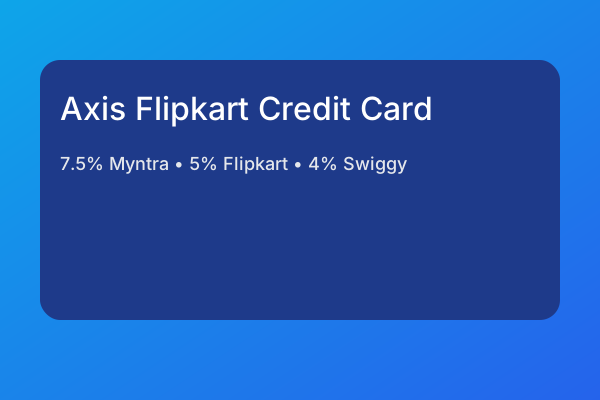
Axis Flipkart Credit Card
If you shop on Flipkart/Myntra often, this card stacks savings on top categories and partners.
- Partnered cashback on Flipkart, Myntra and food delivery
- Strong online commerce focus
- Useful welcome offers on sign-up campaigns
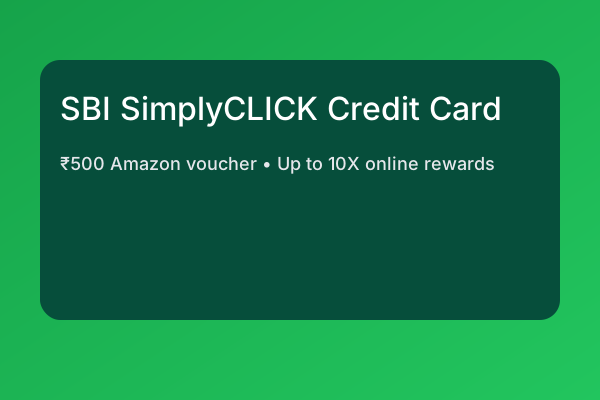
SBI SimplyCLICK Credit Card
Balanced online rewards with a handy welcome voucher. Good for first-time users who want easy value.
- Welcome voucher on popular marketplaces
- Accelerated rewards on partner sites
- Clear redemption and everyday usability
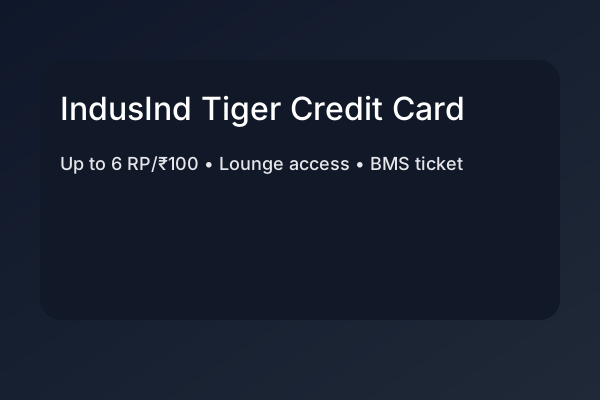
IndusInd Tiger Credit Card
Reward-heavy structure with lounge access and a movie perk. Suits frequent travelers and entertainment lovers.
- Up to 6 reward points per ₹100 spent (program specifics apply)
- Domestic and international lounge entries
- Complimentary movie ticket benefit
Quick Comparison: Rewards, Fees and Perks
| Card | Best For | Key Rewards | Annual Fee | Apply |
|---|---|---|---|---|
| SBI Cashback | Online cashback | 5% online; 1% offline | As per issuer campaign | Apply |
| Axis My Zone | Food & movies | Swiggy up to 40%; B1G1 movies | As per issuer campaign | Apply |
| Axis Flipkart | Flipkart/Myntra | Partnered cashback on e‑commerce | As per issuer campaign | Apply |
| SBI SimplyCLICK | Beginner online rewards | Accelerated partner rewards; welcome voucher | As per issuer campaign | Apply |
| IndusInd Tiger | Travel & lifestyle | Up to 6 RP/₹100; lounge access | As per issuer campaign | Apply |
Annual fees and rates vary by issuer campaigns and profile. Always review official pages before applying. For large purchases, estimate EMI and fees with the Credit Card EMI Calculator.
Best Credit Cards by Profile
Students and New-to-Credit
Prefer lifetime free or low annual fee cards with simple cashback. Keep utilization under 30% and set auto‑pay for the total due. Start small and build a clean history. If an issuer offers a secured variant, consider it to establish track record.
Online Shoppers
Pick a card with consistent online cashback and partner accelerators. SBI Cashback and SBI SimplyCLICK are strong everyday choices. If you shop mostly on Flipkart/Myntra, Axis Flipkart adds incremental savings.
Food & Movies
Axis My Zone is tailored for food delivery and cinema. If you prefer a simpler program, pair it with a cashback card for non‑partner spends.
Travel & Lounge Access
Choose cards that include domestic/international lounge entries and decent earn rates. IndusInd Tiger suits mixed travel and entertainment; confirm network variants and entry caps.
Low Annual Fee or Lifetime Free
Look for spend‑based waivers and lifetime free campaigns via authorized partners. Calculate net value: cashback + rewards + vouchers − fee. If positive and easy to achieve, keep the card.
Fees, APR and Hidden Charges Explained
Understand the complete cost to avoid surprises. Key components include annual/renewal fee, joining fee, finance charges (APR) on revolving balances, cash advance fees, processing fees for EMI conversions, late payment charges, and foreign transaction markups. APRs differ for retail, cash and EMI—revolving retail balances often carry the highest effective cost. To keep costs low, pay the total amount due every billing cycle, avoid cash advances, and prefer genuine no‑cost EMI where merchants subsidize interest.
Fuel surcharge waivers reduce pump fees but may have monthly caps; check network acceptance and MCC categorization. Bill payments earn rewards on some cards but can be excluded on others—review program rules. For international transactions, turn off dynamic currency conversion and pay in local currency to avoid poor exchange rates.
Apply Credit Card Online: Eligibility & Documents
Most banks provide end‑to‑end digital journeys. Keep KYC ready (PAN, Aadhaar), address proof, salary slips, and bank statements. Approvals depend on income, city, employer category and your credit profile. If your report is thin, start with a beginner card or a secured card against a fixed deposit. Respond promptly to verification calls and e‑mandate steps to speed up disbursal.
Before you apply, check your credit score and reduce utilization on existing cards. Avoid bunching multiple applications in a single week. If offered a spend‑based annual fee waiver, confirm exact thresholds and excluded categories to plan usage without stress.
Maximize Rewards Without Stress
Keep It Simple
Use one primary cashback card for general online spends and one partner card for your favorite platforms. This two‑card approach avoids complexity while capturing most value.
Automate and Track
Turn on app notifications, lock/unlock controls, and auto‑pay the total due. Review statements monthly and redeem points before expiry. Screenshot time‑bound offers for proof.
Avoid “Burning” Value
Wallet loads, rent, government payments and fee transactions may not earn rewards. Check program exclusions and MCC rules. Don’t convert purchases to EMI unless the effective APR is favorable.
Upgrade Thoughtfully
If your spending pattern evolves, consider upgrades that align with travel or lifestyle. Confirm whether benefits justify any increase in annual fee and whether spend‑based waivers are achievable.
FAQs
What is APR on credit cards?
APR is the annual percentage rate that reflects the true cost of borrowing on a card when you revolve balances. It combines the interest rate and certain fees to show the yearly cost. In India, APRs typically vary by issuer, card tier and your risk profile, and can be different for retail transactions, cash advances and EMI conversions. The best way to reduce APR impact is to pay the statement balance in full every cycle, avoid cash advances, and use no-cost EMI only when the merchant or issuer explicitly offers it with clear terms.
How to avoid or offset the annual fee?
Most issuers provide a spend-based waiver on the annual fee. If your annual spending crosses a threshold, the fee is reversed on the next cycle. Alternatively, some cards are lifetime free through authorized partners during limited-time campaigns. You can also offset the fee by calculating your net rewards; if cashback, reward points or partner vouchers exceed the fee over a year, the effective cost becomes neutral or positive. Always check the welcome benefits, renewal vouchers, lounge entries and milestone rewards while deciding whether to keep or upgrade a card.
Do cards offer lounge access and travel perks?
Many mid-range and premium Indian cards include domestic lounge access via RuPay, Visa or Mastercard networks; select cards provide international access through Priority Pass or DragonPass. Perks often include complimentary entries, fuel surcharge waivers, airline discounts, hotel status or co-branded benefits. Read the fine print: entries may be capped per quarter, supplementary cards may have separate limits, and access can depend on network variants. Keep your card’s network and eligibility handy when visiting lounges to avoid surprises at the gate.
How do cashback and reward points really work?
Cashback credits usually appear as statement adjustments and reduce your payable amount. Reward points accrue on eligible transactions and can be redeemed for flights, hotels, vouchers or direct statement credit depending on the program. Point valuations differ widely—air miles and travel portals can yield higher value than generic catalogue redemptions. Many programs exclude fuel, wallet loads, rent or government payments from earning rewards. Check category accelerators (like 5X online spends) and pay attention to monthly caps to avoid missing out on expected earnings.
What about fuel surcharge waivers and bill payments?
Fuel transactions attract surcharge and GST at the pump; many cards provide waivers up to a cap per cycle at partner networks or select outlets. Ensure the transaction is processed as fuel MCC to qualify. For utility bills and rent, some issuers offer points or cashback, but others exclude them or apply different rates. Automate essential bill payments with due-date reminders to avoid late fees. If using apps for rent or utilities, confirm whether the transaction is categorized as a wallet or P2P transfer, which may not earn rewards.
Is converting purchases to EMI a good idea?
EMI conversions spread large purchases into affordable monthly payments. The trade-off is interest and processing fees, which increases total cost. Before converting, compare the effective APR to alternative financing or saving-first strategies. If a merchant offers true no-cost EMI, confirm that the discount or subvention is reflected and there are no hidden fees. Use our Credit Card EMI Calculator to estimate EMI, interest and fees with your issuer’s rates, and set reminders to prepay if charges allow without penalties.
Does closing a card hurt my credit score?
Closing your oldest card can reduce average account age and potentially lower your score temporarily. It can also increase utilization on remaining cards if limits drop. Instead of closing, consider downgrading to a no-fee variant or reducing the limit to a comfortable level. If you do close, clear pending EMIs and rewards first, redeem points, and obtain written confirmation. Keep a healthy mix of credit (cards and loans), maintain low utilization under 30%, and avoid bunching multiple closures and new applications within the same quarter.
How can I safely increase my credit limit?
Issuers periodically offer limit enhancements based on your usage and payment history. You can also request a review by submitting income documents. A higher limit may improve utilization ratio and hence your score, but don’t see it as permission to overspend. Accept increases that match your comfort, and monitor alerts for unusual activity. If you receive a temporary festive-limit boost, note the end date and any special terms. Limit changes should not affect rewards categories but can alter your risk profile if spending habits shift.
What are common exclusions in rewards programs?
Typical exclusions include cash advances, wallet loads, fuel, government and rental payments, fee payments, and some education transactions. International transactions may earn differently, and dynamic currency conversion can reduce value. Read your issuer’s MCC (merchant category code) rules, caps per statement cycle, and partner lists. For co-branded cards, ensure you transact on eligible portals or apps to unlock accelerated earnings. Keep screenshots of offer terms, as short-lived promotions can change without notice and customer support may ask for proof during disputes.
How should I manage multiple cards?
Tag each card to a spending category—groceries, fuel, travel, dining—based on their strongest rewards. Turn on app notifications, auto-pay the total amount due every cycle, and set calendar reminders. Review statements monthly for erroneous charges or duplicate postings. If you carry balances, prioritize repayment on higher APR cards first. Consolidate cards only if their value overlaps and you can’t utilize benefits fully. Responsible multi-card management improves rewards yield without increasing risk or stress.
Any quick safety checklist?
Disable international transactions and contactless by default if not required; enable just-in-time for travel or specific purchases. Avoid sharing OTPs, CVCs or full card numbers over calls or messages. Use issuer apps to lock/unlock cards and set per-transaction limits. Prefer secure gateways and official merchant apps. Report suspicious activity immediately and request card replacement if compromised. Keep helpline numbers saved and monitor statements proactively—quick action limits loss and speeds up resolution.